First track bike: which engine size?
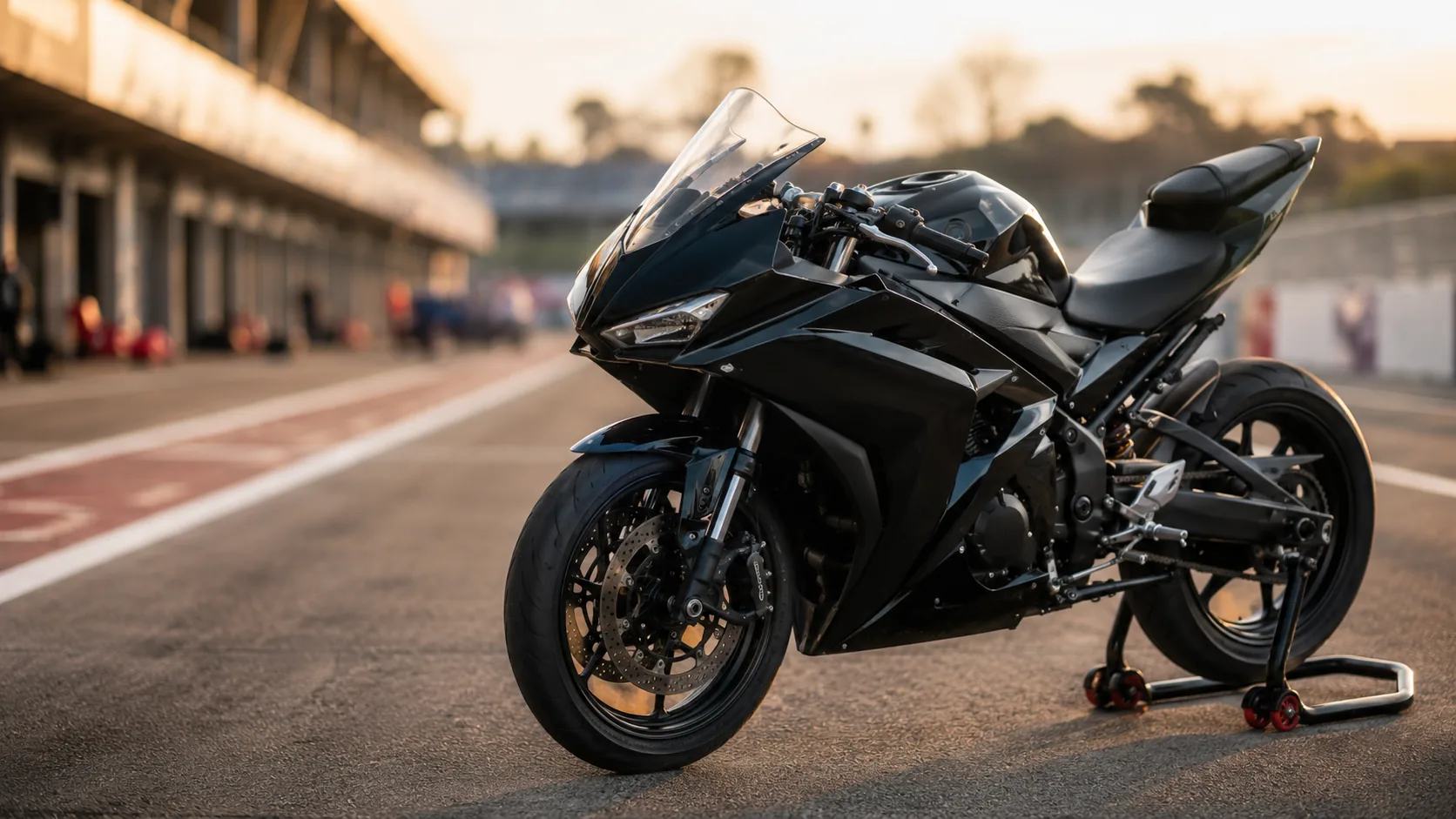
‘Do I need a 600? A 1000?’ It is almost always the first question when you are planning your first track day. And it is almost always the wrong one. The engine size you think you need to ‘keep up’ on a circuit is, in the vast majority of cases, far too big to learn properly.
This article answers a practical question: what engine size should you start track riding with if you want to progress quickly, safely and without burning through your budget? We will look at why horsepower is not the point, what smaller bikes really offer, the case for a versatile twin, the pitfalls of a 600 supersport or a 1000 for a beginner, and why the best answer is often the bike already in your garage.
Engine size is not the real question
On a circuit, progress does not come from power: it comes from the number of laps you complete with confidence. A forgiving bike lets you have another go at a missed line, correct braking that was too late, or get back on the throttle a little too hard without the rear wheel giving you a telling-off. An unforgiving bike makes you freeze: you ride tense, learn little and go home more mentally drained than physically tired.
Three things matter much more than engine size for a beginner:
- Weight. A light bike turns in, stands up and changes direction without a struggle. You correct your mistakes rather than suffer them.
- Smooth throttle response. A progressive engine, with no snatch when you reopen the throttle, lets you manage grip on corner exit — the part that tends to give beginners the biggest fright.
- Margin for error. The less power arrives at once, the easier it is to recover from a mistake. That is exactly what you want when learning.
Remember the line every regular track rider eventually comes out with: on a circuit, the rider makes the difference, not the bike. A well-ridden small bike beats a big one ridden badly — and that is even more true for a beginner.
The 300-400 class: the best place to learn
If you are buying a bike specifically for the track and you are just starting out, small sports bikes are the smartest choice. We are talking about the Kawasaki Ninja 400, Yamaha R3, KTM RC 390 and their equivalents.
Why they work so well:
- Featherweight build (around 165-170 kg) makes the bike astonishingly agile. You can correct a badly chosen line, change direction with the lightest touch and brake with stability.
- Manageable power (40-50 PS) lets you ride ‘flat out’ at much lower speeds than on a big sports bike, so a mistake has smaller consequences. It feels like slow motion — you have time to think, and therefore to learn.
- Tiny running costs: tyres last, the brakes have an easier life, and tyre and pad wear are nothing like those of a 1000.
It is no coincidence that most riding schools use 400s: this is the engine size on which you build the strongest foundations. Many experienced riders keep a small bike for fun, too — these are the bikes that really teach you to carry corner speed rather than hide your weaknesses behind power on the straights.
The versatile twin: a sensible compromise
Between a small sports bike and a 600 supersport sits a popular middle ground: the middleweight twin. Among naked bikes, the Yamaha MT-07 and Suzuki SV650 are the long-standing examples.
The appeal is torque low down in the rev range, so the bike pulls gently out of corners without constant gear changes. Power remains very manageable, weight is reasonable and — a decisive point for many — it is a bike you can use on the road as well.
The ‘softer’ sports bikes: R7 and RS660
This is where a newer category changes things for beginners who want sports bike looks and riding position without a peaky engine: the Yamaha R7 and Aprilia RS660. On paper, they are faired sports bikes — clip-ons, a committed riding position, aggressive styling. But beneath the fairings is a flexible twin-cylinder engine, not a peaky 600 four-cylinder. The R7 is simply the MT-07's twin (around 73 PS) in sports bike clothing; the RS660 takes power a step further (around 100 PS), while keeping a twin's tractability and smoothness.
For a beginner, the benefit is twofold: you develop good sports bike positioning habits from the start (weight forwards, upper body committed), but with a forgiving engine, usable low-down torque and power that does not overwhelm you. If you want ‘a proper sports bike’ without falling into the 600 or 1000 trap, these softer sports bikes often offer the best of both worlds — and remain perfectly usable on the road.
If you do not want a 100% track-only bike, a twin — naked or dressed as a sports bike — is often the best compromise: enough performance to keep you interested as you improve, enough gentleness to leave a margin for error.
The 600 supersport: a classic, but take care
The four-cylinder 600 — R6, CBR600RR, ZX-6R, GSX-R600 — is the ‘default’ track bike in many people's minds. It is rightly a benchmark: a sharp chassis, powerful brakes, a real performance leap over a 400, and a much smaller gap to the 1000s than you might expect.
But for a complete beginner, there are two traps:
- The engine only really delivers high in the rev range. A 600 supersport is flat low down and generous up top: you need to work it hard and use the gearbox well to get the best from it. A beginner who keeps the revs down will find it bland — and one who explores the top end too soon will get into difficulty.
- It is less forgiving than you might think. Riding demands more finesse: a more extreme position, sharper reactions, higher corner speeds. These are excellent bikes for progressing once the basics are in place, less so for learning those basics.
Verdict: an excellent second track bike, or a first one for a beginner with genuine road experience who knows they are going to commit. Not the most relaxed choice for a very first outing.
The 1000: a tempting mistake for beginners
Let us be blunt: starting track riding on a 1000 superbike (R1, S1000RR, Panigale, ZX-10R) makes life harder. There is so much power that you will use only a fraction of it for months, braking and acceleration demand a riding level you have not yet reached, and the smallest throttle mistake on corner exit can be costly. You learn to manage the bike rather than learn to ride it. Save it for later, when you know what to do with it.
‘What about the bike I already own?’
This is often the best answer of all. For a first track day, riding the bike you already own is almost always the right choice: you know it, you do not have to invest in another bike, and the aim of a first day is not to set a lap time but to discover the circuit, the rhythm, the sensations and the safety of the environment.
Naked bike, road-focused adventure bike, middleweight sports bike: all can take part in a beginner track day, as long as the bike is in good condition. Check the essentials — tyres, brakes, fluid levels, chain slack and possible leaks — and come as you are. Our guide to preparing your bike for a circuit (in French) covers the checks to make before loading the trailer. After a day or two, you will know whether you want a dedicated bike — and exactly which one, because you will have identified what is holding you back.
Beyond engine size: what really changes the feel
Once you have chosen the bike, two changes matter more than a few extra horsepower:
- Tyres. Rubber suited to the circuit transforms confidence far more than extra power. This is the first place to spend once you get a taste for track riding.
- Gearing. Matching the final drive ratio to a short, twisty circuit (more acceleration) or a big, fast track (more top speed) radically changes the feel, without touching the engine. To understand what a front or rear sprocket change will do on your exact bike, use our motorcycle gearing calculator: it knows the standard ratios for hundreds of models and simulates the effect of every tooth.
In other words, do not look for the engine size that will ‘make you fast’. Look for the bike on which you will complete plenty of confident laps — the rest can be adjusted.
Where to start in practice
If you boil all this down to a decision:
- You are buying a track bike and really are a beginner → a 300-400 sports bike. The best balance of learning, fun and budget.
- You want a bike for track AND road → a middleweight twin: a naked (MT-07, SV650) or a ‘softer’ sports bike (R7, RS660) if you want sports bike looks and riding position.
- You already have experience and are committed → a 600 supersport.
- You just want to do your first track day → the bike you already own.
Whatever the bike, you will start in the beginner group, with an appropriate pace and supervision — that is what matters, not the specification sheet. To understand how track day levels work, read our article on motorcycle track day ability groups (in French), and if it is your very first time, the complete first track day guide will help you avoid the classic mistakes.
Ready to get started? Browse the motorcycle track days for beginners (in French) on Tarmago and book the day when you will discover that, yes, your current bike is more than enough.