Paul Ricard: layouts, Mistral and riding tips
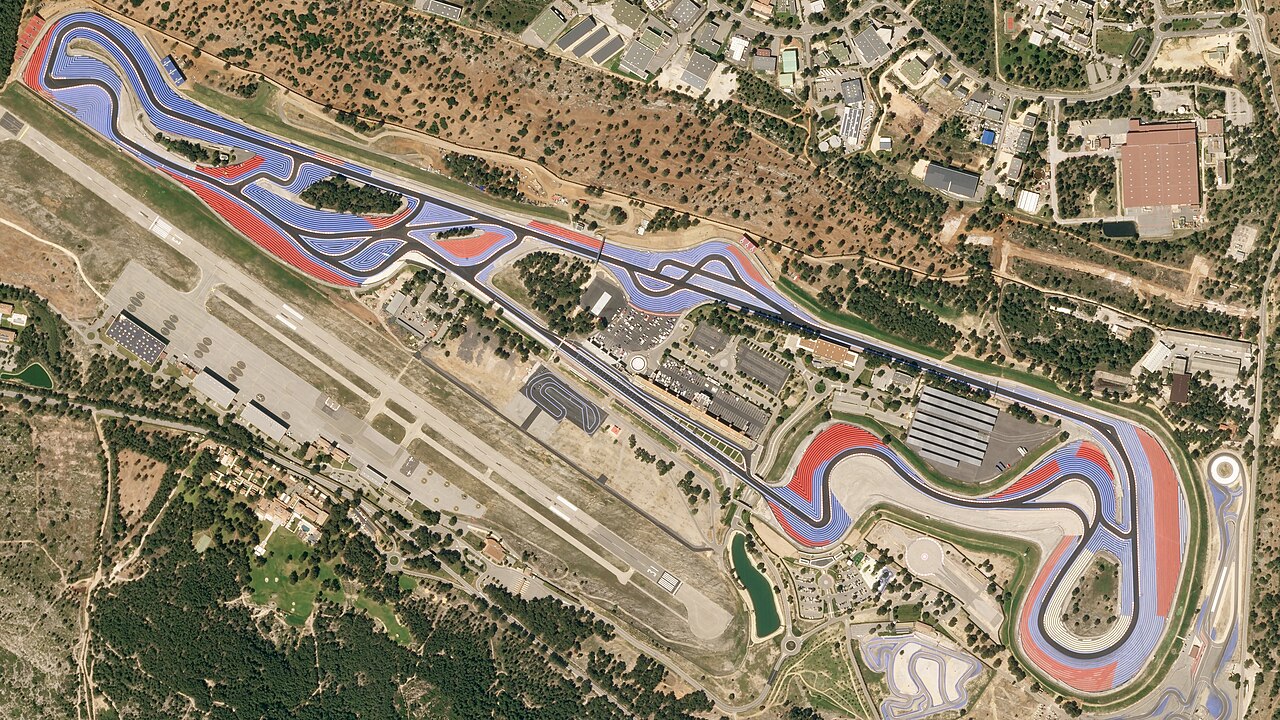
Circuit Paul Ricard at Le Castellet is probably the most iconic French circuit for motorcycle riders. Host of the French F1 Grand Prix until 2022, venue for the Bol d'Or and numerous motorcycle Grands Prix, it is a European benchmark. Whether you want your first ‘proper’ track day on a former F1 circuit or to lower your lap times on a fast, technical layout, Paul Ricard is a must. Here is everything you need to know before booking.
The circuit at a glance
| Feature | Detail |
|---|---|
| Location | Le Castellet (Var, 83) |
| Available layouts | More than 160 (including 3.8 km and 5.8 km) |
| GP length | 5.842 km |
| Short layout length (the most common for bikes) | 3.8 km |
| Corners | 15 (GP layout) |
| Longest straight | Mistral — 1,800 m |
| Track width | 12 m |
| Altitude | 400 m |
| Surface | Very good (resurfaced regularly) |
| Unique feature | Blue and red abrasive run-off strips |
➜ Full Circuit Paul Ricard profile with photos, GPS coordinates and records.
History and heritage
Built at the initiative of Paul Ricard himself (yes, the pastis!) in 1969-1970, the circuit was ahead of its time on safety: generous run-off, open corners and dedicated medical facilities. It was long a favourite winter testing venue for F1 teams thanks to its mild climate (200 days of sunshine a year).
On the motorcycle side, the circuit has hosted:
- The Bol d'Or 24-hour motorcycle endurance race, back at Le Castellet since 2015
- The French motorcycle Grand Prix, for the last time in 1999
- World Superbike (WorldSBK), once, in 1989
- Countless test sessions for factory teams
It is also a high-tech circuit: the redevelopment of the early 2000s completely rethought safety with abrasive run-off strips. In practice, beyond a corner you reach blue asphalt (high speed) or red asphalt (very high abrasion), which slows both bike and rider sharply without gravel. It is unique in the world.
The layouts: which will you choose?
Paul Ricard offers more than 160 layouts, up to the full Grand Prix circuit. The circuit highlights three of them: 5.8 km, 3.8 km and a 1.8 km school track. On a motorcycle track day, you will generally ride one of the first two:
The 3.8 km layout (the most common for bikes)
The circuit describes it as the layout most used for motorcycle courses. Shorter than the Grand Prix circuit, it is quicker to learn and gives you more laps per session. Ideal for beginners and intermediates.
The 5.8 km layout (Grand Prix)
This is the layout used for major races, with the Mistral straight and the Beausset double right-hander. Some variants split the Mistral with a chicane. For experienced/expert riders who want the full experience. More demanding, longer and more mentally taxing.
How do you know which one you are booking?
Check the organiser's event listing or ask before booking. Reputable organisers always specify the layout (3.8 km, 5.8 km or another). Watch out for the codes: in the circuit's own naming, ‘1C’ is a 5.8 km variant, not the short layout.
The track, section by section
The sections below are those of the 5.8 km layout, in lap order. The 3.8 km layout uses part of them: ask the organiser for its map.
The Verrerie esses
The first sequence after the pit straight: a left then a right, demanding a lot of weight transfer. This is where technically skilled riders make the difference.
Tips:
- Work on flow rather than outright speed.
- Do not brake between changes of direction — keep the bike loaded.
Sainte-Baume
The right-hander before the Mistral straight: it sets your speed all the way down the straight. It works the right-hand side of the tyre hardest (uneven heat build-up).
The Mistral straight
The moment that makes Paul Ricard unique. 1,800 metres of straight without the chicane, where you will take your 1,000 cm³ bike up to 270-310 km/h, depending on the bike and the wind. At the end comes heavy braking: for the chicane when the layout uses it, otherwise before Signes, which you reach at very high speed.
Tips:
- First laps: do not push. Brake early, before the 200 m board, then move your braking point closer lap by lap.
- The Mistral is never completely flat — a slight climb subtly reduces top speed.
- Watch the wind: when the mistral (the wind!) blows, you can lose 15-20 km/h at the top end and the bike moves around on the straight.
Signes corner
Iconic. Taken almost flat out, it is one of the fastest corners in motorcycle riding. The vast run-off areas leave room if you make a mistake, but a crash at this speed is still a serious one.
Tips:
- Only start really attacking Signes halfway through the day, once you are confident and the tyres are up to temperature.
- Line: enter from the outside, take a late apex and run wide on exit to carry speed away.
- Turn in too early and you compromise the exit, losing 20 km/h throughout the next sector.
The Beausset double right-hander
A long double right-hander straight after Signes, where you stay leaned over for a long time: one of the most demanding sections of the circuit.
Ability level: who can ride at Paul Ricard?
Beginners: yes, with conditions
Paul Ricard is more accessible to beginners than you might think, thanks to:
- The track's width (12 m), which forgives inaccuracies
- The reassurance of the abrasive run-off strips
- The 3.8 km layout, which is quicker to learn
Conditions for a successful first track day:
- Entry in a strictly beginner-only group (extended briefing)
- One-to-one coaching recommended for the 1st morning
- Mental preparation: on the 5.8 km layout, the length of the track can be unsettling at first
Intermediates: ideal territory
Probably the best French circuit for improving as an intermediate rider:
- Sessions of 20 min allow 6-8 laps, enough to experiment
- A variety of corners = plenty of different techniques to practise
- Generous safety margins
Experienced/experts: a demanding test
For fast riders, Paul Ricard separates the good from the excellent:
- Tyre temperature management at Sainte-Baume and Signes
- Getting the most from the Mistral (aerodynamics, rider position)
- Millimetre precision at Beausset for exit speed
- The benchmark at the very top: 1:50.9, the 2025 Bol d’Or pole (5.673 km layout)
Weather and riding conditions
Paul Ricard enjoys a Mediterranean climate, with ~200 days of sunshine a year. But there are a few things to know:
- The mistral (a northerly wind, common in spring): can reach 80 km/h. It unsettles the bike on the straights, reduces top speed and brings a significant wind chill.
- Summer (July-August): temperatures on track can reach 35-38°C. Keeping the rider cool is critical. Many organisers avoid the hottest months.
- Winter (Dec-Feb): track days are rarer, but still possible. Tyre grip can drop below 12-15°C — warming up gradually is essential.
Ideal seasons: April-June and September-October. These are also the most popular months (book early).
Prices and organisers
How much a Paul Ricard track day costs
Paul Ricard is one of France's most expensive circuits, reflecting the circuit hire cost:
| Type of day | Average price in 2026 |
|---|---|
| Standard track day, 3 groups (3.8 km) | €290-340 |
| GP track day (5.8 km) | €320-390 |
| 2-day weekend package | €540-680 |
| Full-day one-to-one coaching | €100-150 |
➜ View all Paul Ricard track days with transparent prices.
The main organisers
- First on Track: premium offering, GP days, intermediate/experienced riders
- Motors Events: plenty of dates + a clear ability-group policy, a good beginner/intermediate mix
- AGS Events: friendly atmosphere, reasonable prices
- Track Riders: rare at Paul Ricard, but possible (often packaged with another circuit)
Logistics: getting there and where to stay
Access
- Address: 2760 Route des Hauts du Camp, 83330 Le Castellet
- GPS coordinates: 43.2506° N, 5.7918° E
- From Marseille: 60 km, 1 h via the A50 + D8n
- From Toulon: 35 km, 40 min
- From Lyon: 310 km, 3 h
- From Paris: 750 km, 7 h 30 min — many riders prefer to fly (Marseille-Provence) + hire a bike on site
- Nearest airport: Marseille-Provence (50 km, 45 min)
Parking is free and spacious. Paddock access starts early in the morning (briefing often at 8:30 am).
Recommended hotels
Around the circuit:
- Hôtels du Castellet (luxury, on site) — €200-400/night
- Bandol (15 min) — a wide range at €80-200
- La Ciotat (20 min) — often the best value for money
- Toulon (35 min) — an option if Bandol/Ciotat are fully booked
Book 3-4 weeks ahead in high season. Many riders from Paris stay for 2 nights (D-1 and D0) to make the most of the trip.
Food on site
- Restaurant + snack bar in the paddock
- Vending machines for snacks
- Many riders bring lunch to make the most of the time between sessions
Facilities and services
Paul Ricard has international-standard facilities:
- Paddock: 250+ tarmac pitches with power sockets (paid option)
- Garages: available to hire through premium organisers
- Showers and toilets: clean and plentiful
- Doctor + ambulance: on site at all times
- Parts shop: on some days (depending on the partner organiser)
- Compressor: available
- Wi-Fi: paddock coverage
7 tips to get more from your Paul Ricard track day
- Arrive early: briefing is at 8:30 am, but arrive between 7:30 and 8 am to unload without rushing and choose a good paddock spot.
- Mistral in the morning: mornings are generally less windy than afternoons. Set your best lap between 11h and 13h.
- Build up your speed: allow 2 warm-up sessions before attacking Signes flat out. Tyres take time to reach temperature on this track.
- Tyre management: Sainte-Baume wears the right side. If you ride 6 sessions, vary your pace to even out the wear.
- Hydration and food: a long day, a large paddock — bring 2 L of water and a proper meal. Avoid steak and chips at lunchtime (digestion → lethargy afterwards).
- Camera and photos: the rules (on-board cameras, mounts) vary from one organiser to another. Check with yours before riding.
- Final familiarisation: walk the paddock–restaurant–track route before your 1st session. You will save yourself 10 min of stress during the day.
What lap times to aim for at Paul Ricard
A lap time only means something on a given layout: between 3.8 km and 5.8 km, with or without the Mistral chicane, times are not comparable. Ask the organiser for the layout first.
The only reliable public benchmark: pole position at the 2025 Bol d’Or, a round of the Endurance World Championship, went to Étienne Masson (Yoshimura SERT Motul) in 1:50.932 on the 5.673 km layout. On a track day, the most useful comparison is with yourself, from one day to the next, on the same layout.
FAQ
Do you need specific insurance to ride?
Yes — your standard motorcycle insurance does not cover track riding. Either the organiser provides track third-party liability insurance (the most common arrangement), or you take out dedicated cover with Lestienne or April Moto.
Can you hire a bike on site?
Yes, several providers offer Yamaha R6, R7 or Aprilia RS660 hire directly in the paddock. Allow €250-450/day, depending on the bike. Book 4-6 weeks ahead.
Is safety really better than elsewhere?
That cannot be shown: no public statistics compare circuits with one another. The vast run-off areas leave room to slow down after a mistake. That said, no circuit is ‘safe’. Full approved protective kit remains essential.
What is the best month to ride?
May-June and September-early October. Stable weather, not too hot, long days. April can be windy; July-August very hot.
Book your Paul Ricard track day
➜ View all Paul Ricard track days in 2026 ➜ Full-season calendar ➜ Track days by major city: near Marseille (in French), near Lyon (in French)
Further reading
- Paul Ricard vs Magny-Cours comparison (in French)
- First motorcycle track day: the complete guide
- Cheap motorcycle track days: 7 tips (in French)
Enjoy your riding at Le Castellet — and make the most of the Mistral, both the wind and the straight!