Track bike preparation: road bike to circuit
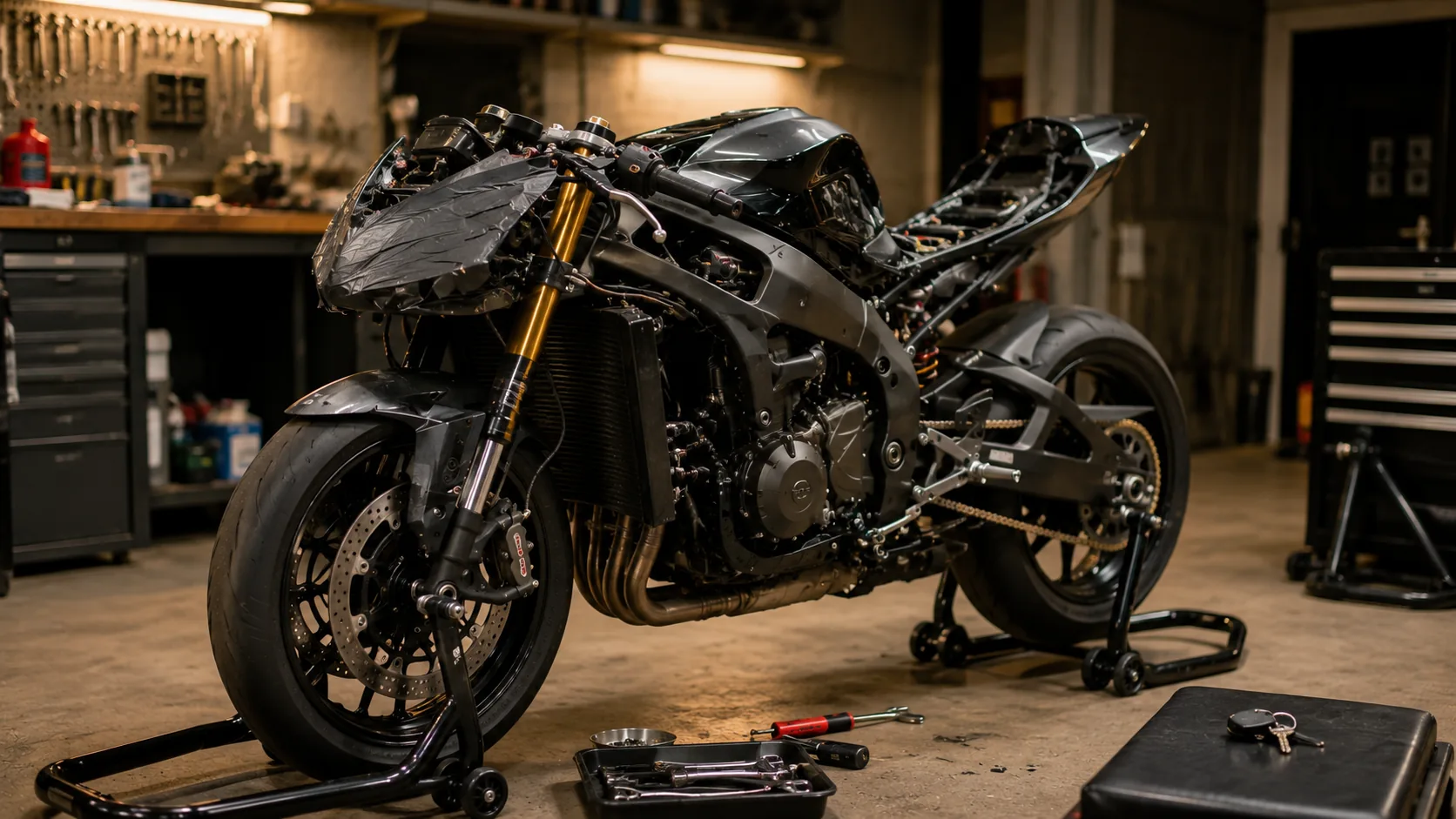
For your first track day, your road bike is fine as it is — check the tyres, brakes and fluid levels, and you are ready to ride. But once you get a taste for the circuit, one question keeps coming up: how do you ‘prepare’ a bike for the track? Preparation here does not mean making it more powerful. It means making it compliant, safe, protected and suited to demands it never faces on the road.
This article takes you through the transformation from road bike to track bike, step by step. From the bare regulatory minimum to track consumables, via protection and gearing — with the right priorities at each stage, so you do not spend everything at once.
For a quick checklist to work through before every track day (tyres, brakes, fluid levels, chain slack), see our dedicated article on checks before a track day (in French): here, we are talking about the underlying preparation you do once in the workshop.
Step 0: do nothing (and that is fine)
The first money-saving truth: a well-maintained road bike needs no major preparation when you are starting out. Tyres in good condition, pads with some bite, no leaks and a correctly adjusted chain — that is enough to ride in the beginner group. Preparation comes later, once you know what is holding you back and plan to return regularly.
So there is no need to transform the bike before your first day. Prepare a bike once you have decided to take it on track regularly.
Step 1: the safety basics (and what changes in racing)
At the start of a track day, your bike goes through a technical inspection. For an open session (a recreational track day), this is light-touch: it mainly covers basic safety — tyres and brakes in good condition, no leaks, working controls. The rest is recommended good practice, rather than requirements that are always checked. But these are precisely the things that become compulsory once you start racing: it is worth knowing them so you can prepare the bike to the right standard.
- Mirrors. On a track day, you will at least be asked to fold them in (or tape them over); removing them is recommended but rarely compulsory. For racing, off they come.
- Lights. Taping over the headlight and rear light is strongly recommended — the tape holds broken glass together in a crash — but it is more a good habit than a requirement in open sessions.
- Coolant. Replacing conventional coolant with water (possibly with a corrosion inhibitor) is strongly recommended: glycol spilled after an engine failure is extremely slippery and almost impossible to clean up, making it dangerous for the riders behind you. On track days, however, it is generally neither compulsory nor checked. In racing, it is compulsory — and only pure water is allowed.
- Lockwiring and an oil catch tray. Securing plugs and caps with lockwire and fitting a catch tray: not required on track days, compulsory in racing. If you intend to race eventually, you might as well plan for it during preparation.
- No leaks, on the other hand, is a firm requirement everywhere, including track days: a leak can get you turned away.
In other words, for open sessions, the main thing is a sound bike (tyres, brakes, no leaks) and a few good habits. More extensive preparation (pure water, lockwiring, catch tray) becomes unavoidable once you get a licence and start racing — and neat, properly executed lockwiring is exactly the sort of job you then hand to someone who knows how to do it.
Step 2: protect the bike
A low-speed crash can happen in a moment, even to cautious riders. A few parts limit the damage — and the bill — when you go down:
- Frame-mounted crash protectors (crash pads) take the first impact.
- Engine case covers (engine casing protection): these stop a slide from tearing open a casing and dumping oil onto the track — so they protect everyone else's safety as well as your wallet.
- Axle and fork protectors.
- Folding levers, which fold rather than snap.
This is the best-value investment early in your preparation: inexpensive compared with a repair bill, and reassuring when you ride.
Step 3: consumables and performance
Once the bike is compliant and protected, turn to the things that really change how it feels:
- Track tyres. These are the biggest performance upgrade, by a long way. Tyres suited to circuit riding transform grip and confidence far more than any engine gains.
- Brakes. Pads with more bite, braided brake lines (which eliminate the expansion of rubber hoses and give a firmer lever), and above all high-temperature brake fluid (common racing fluids are DOT 4 fluids with a high boiling point), which holds off vapour lock under repeated braking. If braking performance tails off towards the end of the day, hot fluid is almost always the cause.
- Gearing. Matching the final drive ratio to the circuit radically changes the feel without touching the engine: shorter gearing for strong acceleration on a twisty layout, taller gearing to avoid hitting the rev limiter on a long straight. To see what a front or rear sprocket change does on your exact model, use our motorcycle gearing calculator.
- Race fairings. Further down the line, replace the road fairings with polyester race fairings (lighter, cheaper to replace after a crash, and easier to remove for mechanical access).
All these consumables wear out — and tracking them is exactly what the track bike maintenance logbook (in French) is for: knowing when your tyres, pads and brake fluid are nearing the end of their useful life avoids an unpleasant surprise on the morning of a track day.
Step 4: the settings
Preparation does not stop at parts. Two free adjustments make a big difference:
- Suspension. Setting preload for your weight, then fine-tuning rebound and compression damping, transforms the bike's behaviour. This is often where a beginner gains the most confidence — and where a specialist's eye can save hours of trial and error.
- Control positions. Set the levers, gear lever and brake pedal to suit your build and riding position on track: small details that reduce fatigue and make your inputs more consistent.
Where to start, and when to call a professional
The classic mistake is doing everything at once. The right approach is to build up in stages:
- First track day → road bike + checks, nothing more.
- You come back → good practice (water, mirrors folded in or taped over, lights taped over) + protection.
- You get hooked → track tyres, brakes, gearing.
- You get serious → race fairings, fine-tuning, suspension.
Some jobs are well worth entrusting to a track bike preparation specialist: proper lockwiring, fitting braided brake lines and bleeding the system, suspension set-up, or a full bike conversion. To find one near you, see our track bike preparation specialist directory. Knowing when to hand these jobs over means peace of mind on track — and is often safer than questionable DIY.
The other part of the equation is you: rider kit is not something you ‘prepare’; you buy the right level of protection, as explained in our guide to compulsory motorcycle track day kit (in French). And before committing to major preparation, make sure you actually enjoy it: choose and book your first outing from the motorcycle track days for beginners (in French), ride your bike as it is, and afterwards you will know exactly what to prepare first.