Suspension tool · Road and track
Motorcycle SAG calculator
Measure front fork and rear suspension sag, bike only and with you in riding gear. Six lengths, four results in millimetres.
How to take the three measurementsWhat is sag?
Sag is how far the suspension settles under the bike’s weight, then with the fully equipped rider. Subtract each measured length from the fully extended length.
Useful even without a target
Keep a baseline and compare it after a load change using the same method. Judging whether it suits your setup requires a reference for your bike, fitted suspension and use — a brand name alone is not enough.
Your measurements
Enter the distances between the same points in mm for each state. Front and rear calculations are independent.
From 1 to 2000 mm, with up to one decimal place (comma or dot). These are input limits, not setup targets.
Without an applicable reference, these readings cannot be called too high or too low. Compare them with your manual, not a universal target.
The link includes measurements, comparison mode and any personal references and source. Do not enter private information. Nothing is saved to your account.
How to take the three measurements
Work on level ground. Get help to stabilise the motorcycle and read the lengths. Follow the manual to lift it safely: the suspension being measured must be fully extended, not supported under the wheel or swingarm.
Front and rear measurement points
L1 · Fully extended suspension
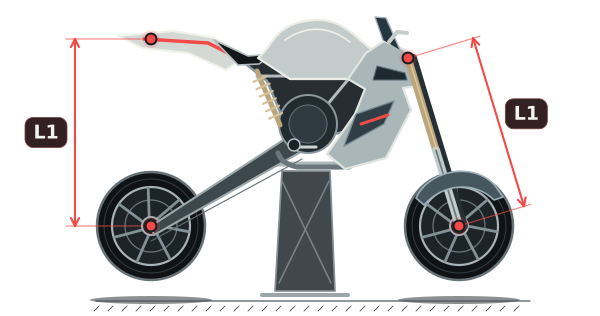
Have the motorcycle lifted and secured according to its manual. Unload the suspension being measured with the wheel off the ground. Measure between the two points at the front and then the rear.
L2 · Bike only
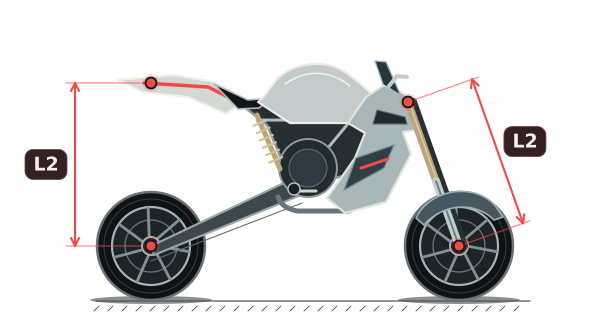
Lower the motorcycle onto both wheels and hold it upright without a rider. Measure the distances again at the same points.
L3 · With you in riding gear
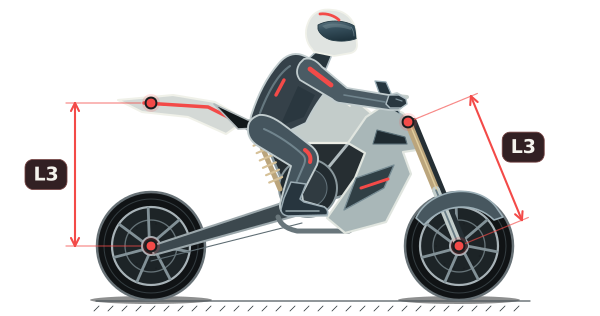
Sit in your normal riding position, wearing your gear. Have another person stabilise the motorcycle while measuring. Record both distances.
At the front, measure from the underside of the upper triple clamp to the wheel axle, along the fork. At the rear, mark a point on the sprung part of the motorcycle directly above the wheel axle. Use exactly the same points for L1, L2 and L3. At the rear, measure movement at the wheel, not shock-shaft travel.
Method adapted from the Öhlins manual, page 10.If measurements differ significantly from the recommendations, Öhlins says to adjust preload according to its manual; if the rider measurement still differs, a different spring is needed (p. 10). KTM works the same way: preload set on the bike-only sag, then a spring chosen for the rider’s weight. The tool derives the direction from this, never a number of turns.
Sag questions
What is the difference between bike-only and rider sag?
Bike-only sag is L1 − L2. Rider sag is L1 − L3, not L2 − L3. Both use the fully extended suspension as their reference.
Is there one SAG value for every track motorcycle?
The calculation works with lengths measured in these three states; the target depends on the bike, fitted suspension and use. Even within Öhlins, the SU 043 mounting instructions for the Suzuki DL650 V-Strom give a different rear rider sag from the general 30 mm kit manual. Selecting a brand alone is not enough. Use the exact manual for your setup; this tool applies no universal value or automatic percentage.
Should I measure the rear shock shaft?
Not for this method: measure between the rear wheel axle and a mark on the sprung part of the motorcycle above it. Repeat this distance for L1, L2 and L3.
Does the tool tell me how many preload turns to add?
No. It compares your sag with the selected document and only gives the direction of the next step, following the Öhlins and KTM method: more or less preload, then a stiffer or softer spring if the gap remains with you on board. The number of turns depends on your suspension: follow its manual or ask a specialist.
Source and limitations
Öhlins · 30 mm Front Fork Cartridge Kit — Owner’s Manual — Road & Track · 07284-01_3
Edition 2019-05-21 · read on 2026-10-18 · page 10
Official document (PDF, in English)Excerpt from the bike-only table (English)
Rear 5 - 15 mm Front 20 - 30 mmInput limits and rounding to one decimal place are specific to this calculator. No ranges from another document are combined with the selected one. The direction given does not diagnose damping or suspension condition.
How the next step is worked out
Preload first, spring second: the method described by Öhlins and KTM. Preload shifts both sag figures by the same amount; only the difference between them depends on the spring. When no preload setting can bring both onto the document’s figures, the tool therefore points to the spring. It only gives a direction, never a number of turns or a spring rate. Adjust in small steps, one at a time, following your suspension manual.
Öhlins · 30 mm Front Fork Cartridge Kit — Owner’s Manual — Road & Track · 07284-01_3
If your measures differ significantly from the recommendations in the Mounting Instructions or the table above, adjust the spring preload.Öhlins · p. 10
If the ride height still differs from the recommendations, you may need to change to softer/harder spring.Öhlins · p. 10
KTM · Owner’s Manual 2025 — 250 SX, 300 SX, 250 XC, 300 XC · 3240042en
If the static sag is less or more than the specified value: – Adjust the spring preload of the shock absorber.KTM · p. 40
Adjusting the riding sag […] Select and mount a suitable spring.KTM · p. 42
Why references depend on the fitted suspension
These manuals describe different applications, not values to mix: Öhlins SU 043 for the Suzuki DL650 V-Strom; K-Tech DDS 155-013-030-020 for the BMW HP4, for competition only. K-Tech also specifies its own fork measuring points. Keep your manual’s method and conditions.
- Öhlins SU 043 — Suzuki DL650 V-Strom — Mounting Instructions
Edition 2017-01-01 · read on 2026-10-18 · page 4
- K-Tech DDS 155-013-030-020 — BMW HP4 — Owner’s Manual
Edition 2017-06-26 · read on 2026-10-18 · page 5